What Happens If You Lose a Receipt?
You may lose tax deductions, reimbursements, and warranty claims — and face audit scrutiny. Here's what to do immediately and how to prevent it with digital archiving.
❓ FAQ – What Happens If You Lose a Receipt?
What happens if you lose a receipt?
You may lose the ability to claim tax deductions, expense reimbursements, warranty coverage, or product returns. In some cases, you may face tax disallowances or audit scrutiny.
Can I still claim a tax deduction without a receipt?
Sometimes. Tax authorities like the Internal Revenue Service, HM Revenue & Customs, and Australian Taxation Office allow alternative documentation under specific rules — but strict conditions apply.
Is losing a receipt illegal?
No. But claiming expenses without proof may lead to penalties or rejected deductions.
Can digital copies replace lost paper receipts?
Yes. Many authorities including Canada Revenue Agency and Central Board of Indirect Taxes and Customs accept digital records if they are accurate and retrievable.
📑 Table of Contents
- Why Receipts Matter Legally
- What Happens If You Lose a Receipt?
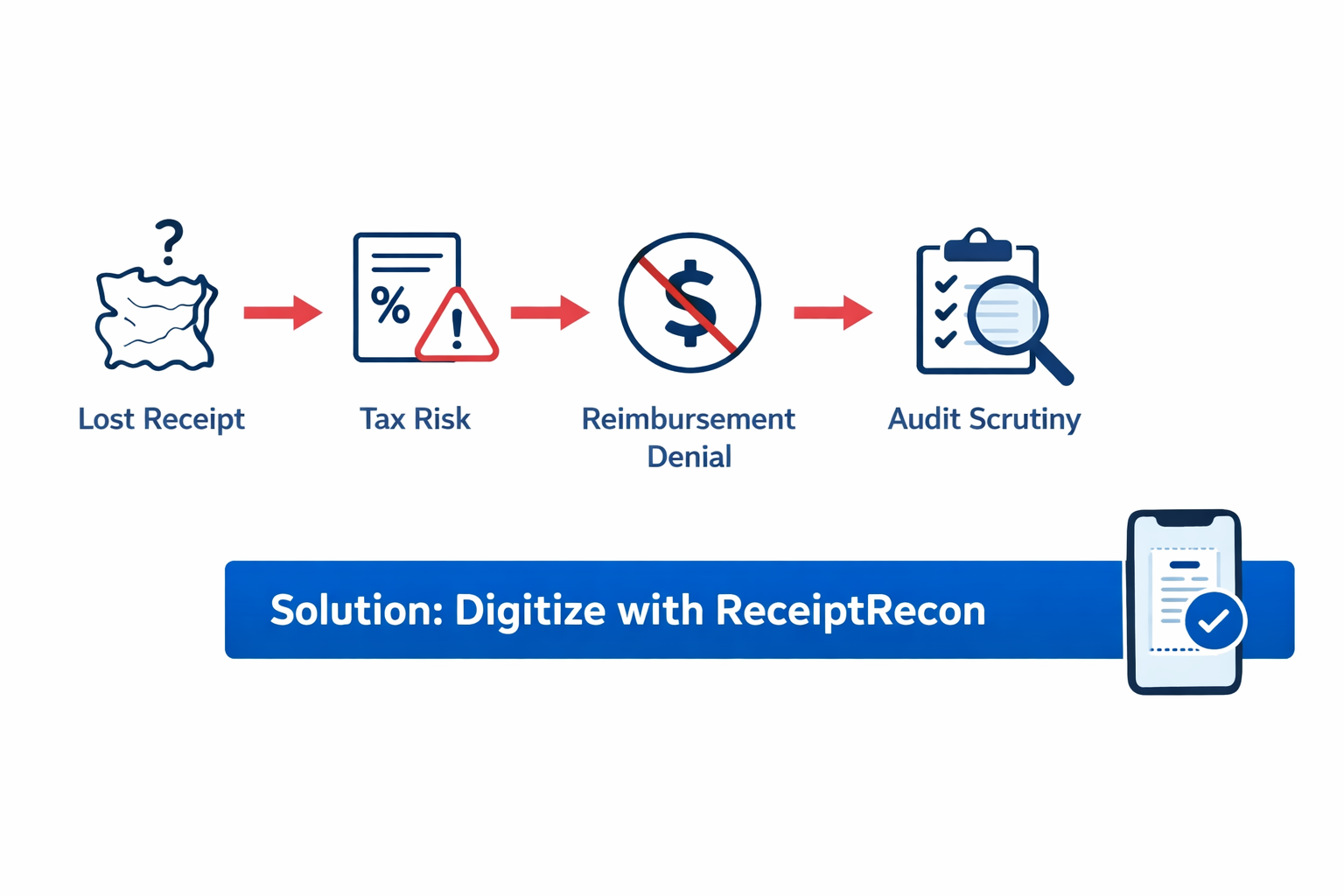
- Lost Receipt Consequences (Flow)
- Country-by-Country Rules (US, UK, India, Australia, Canada)
- Statistics on Lost Receipts & Audit Risk
- Business vs Personal Impact
- What You Can Do Immediately
- Alternative Proof Options
- Paper vs Digital Storage
- How ReceiptRecon Prevents Receipt Loss
- Warning Signs You're at Risk
1️⃣ Why Receipts Matter Legally
Receipts serve as proof of purchase, tax deduction evidence, GST/VAT input credit support, reimbursement documentation, and warranty validation. Tax authorities globally require substantiation of date, vendor name, amount, tax paid, and business purpose. Without this, deductions may be denied.
2️⃣ What Happens If You Lose a Receipt?
You may face: rejected expense reimbursement, denied tax deduction, GST/VAT input credit reversal, warranty claim refusal, and audit flag. Severity depends on amount involved, frequency of missing documentation, type of expense, and country regulations.
Lost Receipt Consequences & Solution
3️⃣ Country-by-Country Rules
🇺🇸 United States
Authority: Internal Revenue Service. Receipts required for most deductions; under $75 a receipt may not be mandatory (travel exceptions). Records 3–7 years. If lost: bank statements alone usually insufficient; you may reconstruct with credit card statements, vendor reissued invoice, or written log.
🇬🇧 United Kingdom
Authority: HM Revenue & Customs. Keep records at least 6 years; digital copies allowed. VAT claims require valid VAT invoice. If lost: VAT input may be disallowed; alternative proof must show VAT number and breakdown.
🇮🇳 India
Authority: Central Board of Indirect Taxes and Customs. GST Input Tax Credit requires valid tax invoice (GSTIN, invoice number, tax breakup). Records 6 years. If lost: ITC claim may be reversed; GSTR-2A mismatch may trigger notice.
🇦🇺 Australia
Authority: Australian Taxation Office. Records 5 years; digital accepted. Small expenses under AUD $82.50 may not need receipt in limited cases. If lost: deduction may be denied; diary records may be used for travel.
🇨🇦 Canada
Authority: Canada Revenue Agency. Must maintain supporting documents; electronic storage allowed. GST/HST claims require proper invoice. If lost: CRA may disallow claim; request vendor duplicate copy.
See global receipt requirements for more.
4️⃣ Statistics on Lost Receipts & Audit Risk
According to the Association of Certified Fraud Examiners: 15% of fraud cases involve expense reimbursement; median loss $40,000 per case. Poor documentation is a common audit trigger. Other research: 1 in 3 employees lose at least one receipt monthly; 40% of small businesses rely on manual storage; paper receipts fade within 12–18 months. Receipt loss is both operational and financial risk.
5️⃣ Business vs Personal Impact
| Scenario | With Receipt | Without Receipt |
|---|---|---|
| Tax deduction | Approved | Risk of rejection |
| GST/VAT credit | Claim allowed | ITC reversal |
| Reimbursement | Processed | Rejected |
| Warranty claim | Honored | Often denied |
| Audit defense | Strong | Weak |
6️⃣ What You Can Do Immediately
Contact vendor → Request duplicate invoice. Check email for digital copy. Review bank statement and accounting software. Write an expense memo (date, purpose, amount). Document reconstruction steps.
How to Recover From a Lost Receipt
- Step 1: Identify transaction – Date, amount, vendor.
- Step 2: Request duplicate – Most vendors can reissue within minutes.
- Step 3: Check payment proof – Credit card statement, bank transfer reference, UPI record (India).
- Step 4: Create written explanation – Business purpose, why receipt missing, efforts made to recover.
- Step 5: Store digitally – Upload to a receipt management system.
7️⃣ Alternative Proof Options
When a receipt is missing, you may use: credit card statements, bank transaction record, purchase order, email confirmation, shipping confirmation, warranty registration, supplier duplicate copy. Acceptance varies by country and audit case.
8️⃣ Comparison: Paper vs Digital Storage
| Feature | Paper Receipts | Digital Storage |
|---|---|---|
| Fading risk | High | None |
| Searchable | No | Yes |
| Backup | None | Cloud |
| Audit ready | Weak | Strong |
| Duplicate detection | Manual | Automated |
9️⃣ How ReceiptRecon Prevents Lost Receipts
ReceiptRecon instantly scans and digitizes receipts, extracts structured fields, stores secure digital copies, enables duplicate detection, organizes by vendor/date/tax, and creates an audit-ready archive. Even if the paper copy fades or is lost, the digital record remains intact.
🔍 Warning Signs You're at Risk
- Storing paper receipts in wallets
- No monthly reconciliation
- Shared email invoices not centralized
- Manual spreadsheets
- No cloud backup
✅ Final Takeaway
Losing a receipt is not illegal — but it is risky. Without documentation you may lose deductions, GST/VAT credit, reimbursements, and increase audit exposure. Digital archiving eliminates the problem entirely.
ReceiptRecon ensures no lost receipts, audit-ready records, structured tax compliance, and a secure searchable archive.
Related Resources
Disclaimer: This content is for informational purposes only. Consult a qualified tax or legal professional for your situation.
🎯 Never Lose a Receipt Again – Digitize in Seconds
ReceiptRecon scans and stores every receipt in a secure, searchable cloud archive so you always have proof for deductions, reimbursements, and audits.