Number at the Bottom of a Receipt: What It Is, Why It Matters, and How to Use It
If you've ever looked closely at a receipt, you've probably noticed a long string of numbers printed near the bottom. Many people ignore it—but for accountants, auditors, retailers, and tax authorities, the number at the bottom of a receipt is extremely important.
This article explains what that number is, why it exists, how it's used for refunds, audits, and recordkeeping, and how freelancers and small businesses should store it properly.
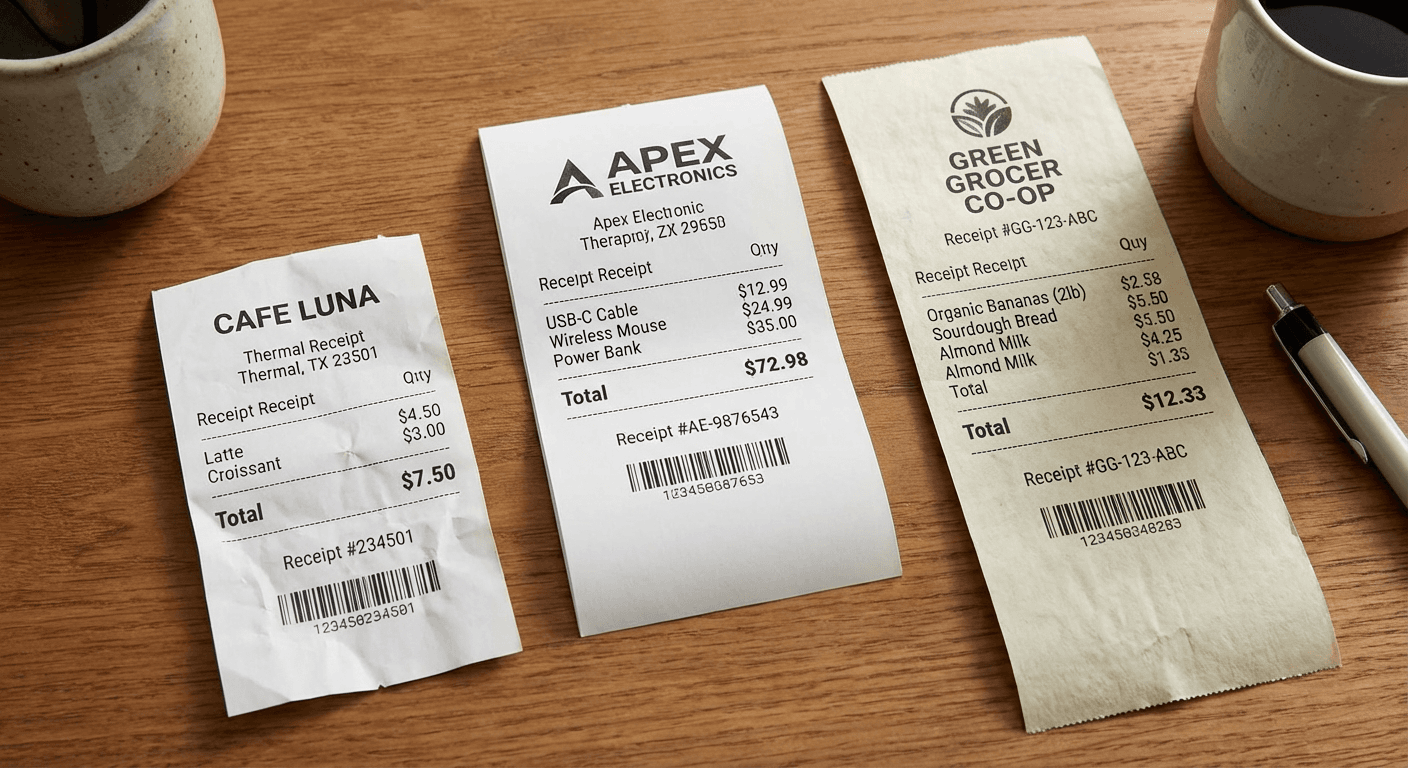
Receipt numbers appear at the bottom of receipts in various formats. Notice the different formats: "Receipt #234501", "Receipt #AE-9876543", and "Receipt #GG-123-ABC".
What Is the Number at the Bottom of a Receipt?
The number at the bottom of a receipt is typically a unique transaction identifier generated by the point‑of‑sale (POS) system. Its purpose is to uniquely identify that exact sale.
Depending on the retailer or system, it may be called:
- Receipt number
- Transaction ID
- Reference number
- Authorization code
- Trace number
- Invoice or document number
Key point: No two receipts from the same system should have the same number.
Why Is the Number at the Bottom of a Receipt Important?
This number plays a critical role in:
✅ Refunds and Returns
Retailers often require the receipt number to locate the original transaction. Without it, processing returns can be difficult or impossible.
✅ Accounting and Bookkeeping
Accountants use receipt numbers to match expenses with bank or credit card transactions. This helps ensure accurate financial records and simplifies reconciliation.
✅ Audits and Tax Compliance
During an audit, receipt numbers help verify:
- When the expense occurred
- That it wasn't duplicated
- That the receipt is authentic
Proper receipt management is crucial for audit readiness. Learn more about what happens if you get audited without receipts and how to organize receipts for audit readiness.
✅ Fraud Prevention
Unique receipt numbers reduce the risk of fake or duplicated receipts, protecting both businesses and consumers.
Where Exactly Is the Receipt Number Located?
Most often, the receipt number appears:
- At the very bottom of the receipt
- Near "Thank you for your purchase"
- Below payment details (card type, authorization code)
- Sometimes next to labels like Ref, Txn, Receipt #, or Transaction ID
Detailed Breakdown of 20 Common Receipt Number Formats
Below are realistic examples of the kinds of numbers you might see at the bottom of a receipt. Formats vary by retailer, POS system, and country. Understanding these formats helps freelancers, small businesses, and accountants decode transactions quickly, verify payments, and ensure compliance during audit checks.
📘 Example 1 — 0008745321
Type: Simple numeric ID
Breakdown: 000 (store or register ID) | 8745321 (sequential transaction counter)
Usage: Common in U.S. and U.K. retail and fuel station receipts
Purpose: Shows the order of transactions processed that day
📘 Example 2 — TXN‑492837465
Type: Transaction ID
Breakdown: TXN (transaction prefix) | 492837465 (unique identifier)
Usage: Global — appears on digital POS systems and e‑commerce receipts
Purpose: Links the sale to digital payment or card authorization
📘 Example 3 — RCP‑2025‑000193
Type: Structured receipt code
Breakdown: RCP (receipt) | 2025 (year) | 000193 (sequence number)
Usage: Often used by accounting software in Asia‑Pacific (e.g., Singapore, Hong Kong)
Purpose: Makes sorting by year and number simple for auditing
📘 Example 4 — 845739201948
Type: Full numeric timestamp + ID
Breakdown: Embedded date/time and machine ID from POS terminal
Usage: European supermarkets and self‑checkout machines
Purpose: Provides traceability for exact time stamp
📘 Example 5 — A1039485726
Type: Alpha‑numeric internal identifier
Breakdown: A1 (register code) | 039485726 (sequence)
Usage: Used in franchise stores — adds machine ID for multi‑location tracking
Purpose:
📘 Example 6 — POS‑000231847
Type: Point‑of‑Sale transaction number
Breakdown: POS (system prefix) | 000231847 (running number)
Usage: Common globally in retail shops and restaurants
Purpose: Links the physical terminal to a transaction log
📘 Example 7 — INV‑98547321
Type: Invoice‑linked receipt
Breakdown: INV (invoice) | 98547321 (invoice reference)
Usage: B2B sales, hotels, and equipment rental receipts
Purpose: Ties the receipt directly to an official invoice record
📘 Example 8 — 20260129‑847392
Type: Date‑based code
Breakdown: 20260129 (transaction date – 29 Jan 2026) | 847392 (sequence ID)
Usage: Common in South Korean and Japanese POS systems
Purpose: Facilitates daily audit trails by date
📘 Example 9 — TRX982734
Type: Short transaction reference
Breakdown: TRX (transaction) | 982734 (unique number)
Usage: Quick‑print receipts — coffee shops, kiosks
Purpose: Combines readability with uniqueness
📘 Example 10 — RCPT#00482917
Type: Customer‑facing receipt number
Breakdown: RCPT# (prefix) | 00482917 (ID)
Usage: Found in North America retail receipts
Purpose: Helps customer service locate sale for returns
📘 Example 11 — 548293‑019283
Type: Two‑part system reference
Breakdown: 548293 (branch or register) | 019283 (transaction)
Usage: Multi‑store or departmental businesses
Purpose: Supports cross‑location reconciliation
📘 Example 12 — AUTH‑739284
Type: Payment authorization code
Breakdown: AUTH = card network authorization | 739284 = approval ID
Usage: Credit/debit card receipts worldwide
Purpose: Verifies bank‑approved transaction
📘 Example 13 — TID:94827361
Type: Terminal ID / transaction hybrid
Breakdown: TID = terminal ID | 94827361 = unique sale number
Usage: Payment processors like Verifone or Ingenico
Purpose: Connects transaction to a specific physical POS device
📘 Example 14 — CHK‑000492
Type: Check or order number
Breakdown: CHK (check/order prefix) | 000492 (running order)
Usage: Restaurants and hospitality
Purpose: Tracks orders and tables
📘 Example 15 — REF‑837492019
Type: Refund or reference number
Breakdown: REF (refund/reference) | 837492019 (entry code)
Usage: Used by customer‑service systems globally
Purpose: Connects a refund to the original sale
📘 Example 16 — SALE‑A392847
Type: Sales transaction identifier
Breakdown: SALE (prefix) | A392847 (transaction ID)
Usage: Point‑of‑sale receipts across U.S. and Canada
Purpose: Useful for differentiating between sales and returns
📘 Example 17 — BILL‑10938475
Type: Billing receipt number
Breakdown: BILL (prefix) | 10938475 (record number)
Usage: Hotels, restaurants, and utilities
Purpose: Supports month‑end financial summaries
📘 Example 18 — DOC‑84739284
Type: Document ID format
Breakdown: DOC (document) | 84739284 (sequence)
Usage: Common in European VAT receipts or service invoices
Purpose: Required for VAT compliance in many EU countries
📘 Example 19 — ST‑2026‑000874
Type: Store/Year/Sequence format
Breakdown: ST (store code) | 2026 (year) | 000874 (transaction)
Usage: Regional chains in the U.K., Australia, and New Zealand
Purpose: Easier year‑end reconciliation
📘 Example 20 — TX‑8473920194
Type: Transaction and region code
Breakdown: TX (transaction prefix) | 8473920194 (unique ID)
Usage: Used by tax‑registered merchants (hence TX)
Purpose: Enables cross‑match with tax records
📘 Example 21 — RECEIPT‑ID‑839274
Type: Multi‑layer receipt identification
Breakdown: RECEIPT‑ID = system prefix | 839274 = unique entry
Usage: E‑commerce receipts and app‑based payments
Purpose: Ensures one‑to‑one mapping between order and receipt
Global Perspective: Receipt Number Formats by Region
Receipt number formats vary significantly by region and country. Here's a breakdown of common formats worldwide:
| Region | Common Format | Notes |
|---|---|---|
| 🇺🇸 United States | Numeric or `TXN-#######` | POS and credit card systems |
| 🇬🇧 United Kingdom | `RCPT#`, `ST-YYYY-####` | Retail shops, VAT records |
| 🇪🇺 Europe | `INV-####` or `DOC-####` | Required for VAT compliance |
| 🇦🇺 Australia | `ST-####-####` | ID includes store and year |
| 🇸🇬 Asia Pacific | `RCP-YYYY-####` | Popular in GST/VAT receipts |
| 🌐 Global E‑com | `TXN`, `TRX`, `AUTH` codes | For card authorization & order matching |
Understanding these regional differences helps when processing international receipts or working with global clients.
Are Receipt Numbers the Same as Invoice Numbers?
Not always. Here's the key difference:
| Receipt Number | Invoice Number |
|---|---|
| Proof of payment | Request for payment |
| Generated at checkout | Generated before payment |
| Used for returns | Used for billing |
| Common in retail | Common in B2B |
Many small businesses confuse the two, which can cause bookkeeping errors. A receipt confirms payment was made, while an invoice requests payment.
Do All Receipts Have a Number at the Bottom?
Most do—but not all. You may not see a receipt number on:
- Very old receipts (pre-digital POS systems)
- Handwritten receipts
- Some small vendor receipts
- Certain types of digital receipts
However, most modern POS systems generate unique transaction identifiers, making receipt numbers standard practice.
How Small Businesses Should Use Receipt Numbers
1. Log Receipt Numbers in Accounting Platforms
When entering expenses into accounting software like QuickBooks or Xero, always include the receipt number. This makes it easier to:
- Match receipts to bank transactions
- Verify expenses during audits
- Process returns or refunds
- Prevent duplicate entries
For comprehensive guidance on organizing your receipts, see our guide on how to organize receipts for audit readiness.
2. Match Them to Digital Copies
When scanning receipts with tools like ReceiptRecon, ensure the receipt number is clearly visible and captured. This creates a complete digital record that includes:
- The receipt image
- Extracted transaction data
- The unique receipt number
- Date and vendor information
3. Avoid Duplication
No two receipts should share the same ID in your ledger. If you see duplicate receipt numbers, it could indicate:
- A duplicate transaction
- A system error
- Potential fraud
4. Use Automation
ReceiptRecon's AI can capture and extract receipt numbers automatically for faster reconciliation. This eliminates manual data entry and reduces errors. Learn more about how AI receipt scanning works compared to traditional OCR and why AI-powered solutions provide better accuracy.
Best Practices for Storing Receipt Numbers
- Always capture the full number — Don't truncate or abbreviate receipt numbers
- Store with the receipt — Keep receipt numbers linked to the original receipt image
- Include in your accounting system — Add receipt numbers as a reference field
- Use for reconciliation — Match receipt numbers to bank statements and credit card transactions
- Keep for audits — Receipt numbers are essential for tax audits and compliance
Common Questions About Receipt Numbers
Can I use a receipt without the number?
While possible, it's not recommended. Receipt numbers help verify authenticity and process returns. Always try to keep receipts with visible numbers.
What if the receipt number is faded or missing?
If a receipt number is unreadable:
- Take a clear photo before it fades further
- Store the receipt digitally immediately
- Note the issue in your records
- Contact the vendor if you need a replacement receipt
Do digital receipts have numbers?
Yes, most digital receipts (email receipts, app receipts) include transaction IDs or receipt numbers, often in the subject line or footer.
Are receipt numbers required for tax deductions?
While not always legally required, receipt numbers significantly strengthen your case during an audit. They provide proof of authenticity and help verify the transaction.
Conclusion: Why Receipt Numbers Matter
The number at the bottom of a receipt isn't just random digits—it's a critical identifier that:
- Enables refunds and returns
- Simplifies accounting and bookkeeping
- Supports audit compliance
- Prevents fraud
- Links transactions across systems
For freelancers and small businesses, properly capturing and storing receipt numbers is essential for:
- Accurate financial records
- Smooth tax preparation
- Audit readiness - Learn how proper receipt organization protects you during audits
- Efficient expense management
Understanding receipt numbers is just one part of proper receipt management. If you're facing an audit, read about what happens when you don't have receipts and how to protect yourself.
Related Resources
Disclaimer: This content is for informational purposes only and does not constitute tax or legal advice. Receipt number formats vary by system and region. Always consult a qualified tax professional for advice specific to your situation.
🎯 Tired of Managing Receipts? Let's Make It Easy
Make receipt number management effortless. Stop manually entering receipt numbers. ReceiptRecon's AI-powered receipt scanner automatically captures, extracts, and stores receipt numbers from receipts worldwide.